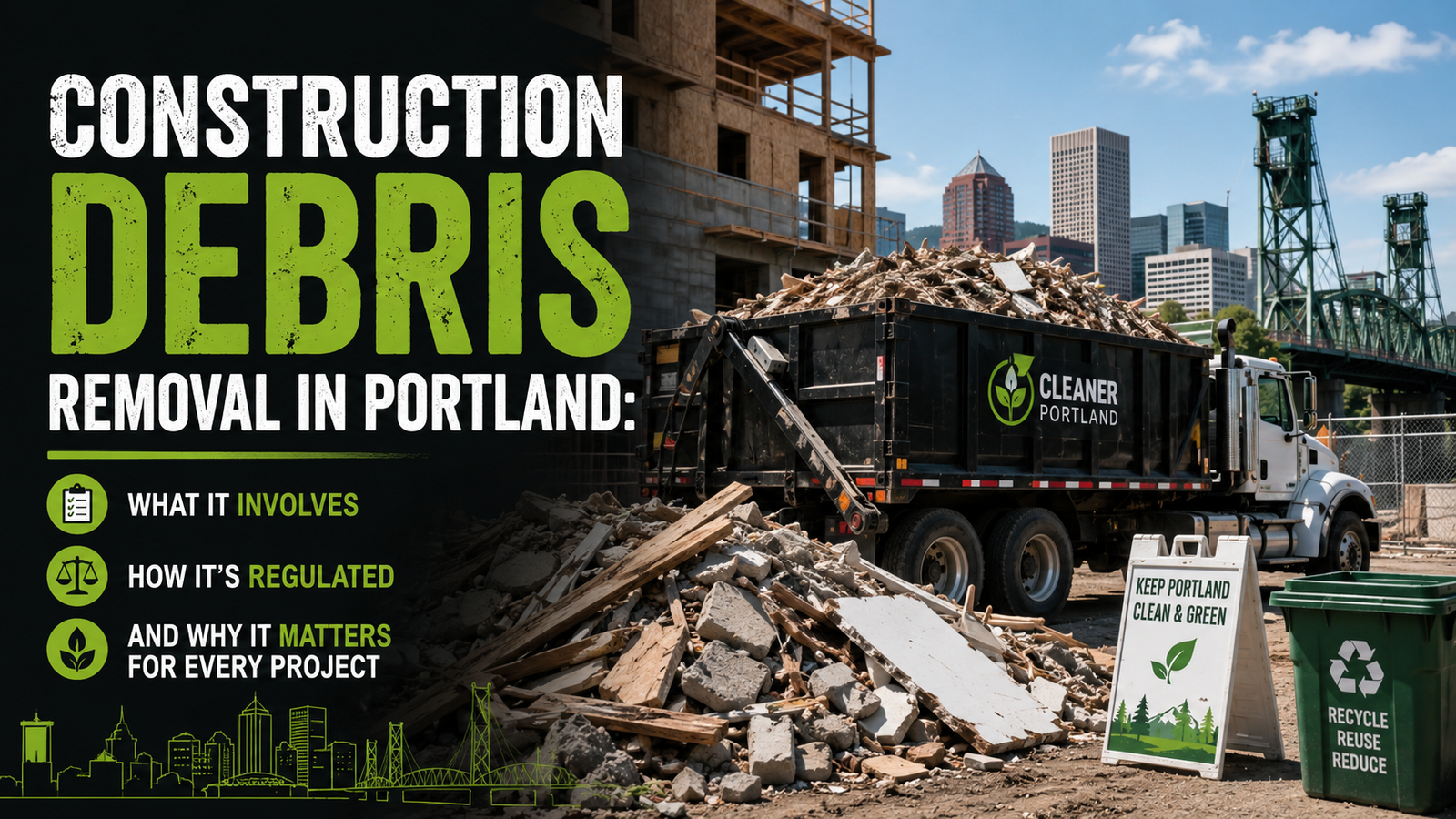
Every construction, renovation, and demolition project in Portland generates waste. From the framing lumber end-cuts and drywall scrap of a residential remodel to the concrete rubble, structural steel, and demolition debris of a large commercial teardown, construction activity produces a continuous stream of material byproducts that must be systematically collected, transported, and properly processed or disposed of. Construction Debris Removal Portland is not simply a matter of filling a dumpster and hauling it away it operates within Oregon’s robust environmental regulatory framework, must account for the region’s specific infrastructure of recycling and disposal facilities, and requires expertise in material handling, hazardous material identification, and the logistics of managing debris efficiently on active job sites. This guide explains what construction debris removal in Portland actually involves, why Oregon’s regulatory environment shapes how it is done, and what contractors, property owners, and project managers need to understand.
What Construction Debris Removal Covers
Construction debris removal is a broad category that encompasses the collection, loading, transportation, and proper disposal or recycling of all waste materials generated during construction, renovation, or demolition activity. It is distinct from ongoing site housekeeping (the daily tidying that individual tradespeople perform as part of their own work), from post-construction final cleaning (which prepares completed spaces for occupancy), and from the routine municipal garbage collection that handles everyday household and commercial waste. Construction debris removal specifically addresses the accumulation of building materials, packaging, cut-offs, and demolition material that requires organized, often large-volume removal from active project sites.
The material categories that fall within construction debris removal in Portland span a wide range. Concrete and masonry from foundation work, slab cutting, block wall demolition, and concrete flatwork removal constitute some of the highest-volume material in many Portland construction and demolition projects. Wood waste, including dimensional framing lumber, engineered wood products like OSB and LVL, treated lumber, plywood, hardwood flooring, and rough carpentry cut-offs, represents the single highest-volume category on most residential construction sites. Metal scrap structural steel, reinforcing bar, copper and galvanized plumbing pipe, aluminum, sheet metal, HVAC components, and electrical wire has significant recyclable value and is consistently separated for recycling in Portland’s active scrap metal market.
Drywall and gypsum board waste is generated in substantial quantities during both new construction and renovation. Gypsum has specific recycling pathways in the Portland market clean, unpainted drywall scrap can be processed as gypsum recycling feedstock at participating facilities, reducing landfill disposal and supporting a circular material economy. Roofing material, including asphalt shingles, modified bitumen roofing, TPO and EPDM membrane, and related underlayment and flashings, is a significant debris category for roofing projects and building teardowns. Packaging and wrapping material the cardboard, foam, plastic banding, and stretch wrap that arrives with virtually every material delivery to a construction site is a continuous and often underestimated debris stream that accumulates throughout the project.
Oregon’s Regulatory Framework for Construction Debris Management
Portland construction debris removal operates within one of the most comprehensive environmental regulatory frameworks for construction and demolition waste in the United States. Multiple overlapping regulatory authorities the Oregon Department of Environmental Quality (DEQ), Oregon Metro, the City of Portland, and the Construction Contractors Board (CCB) each play specific roles in governing how construction waste is managed in the greater Portland area.
Oregon DEQ Asbestos Survey Requirements
One of the most critical regulatory requirements affecting construction debris removal in Portland and one that is commonly misunderstood by property owners and even some contractors is Oregon’s mandatory asbestos survey requirement before demolition or renovation work begins. Under Oregon Administrative Rule Chapter 340, Division 248, and Oregon Revised Statutes 468A.757, all commercial buildings regardless of their construction date must have an asbestos survey conducted by an accredited inspector before any demolition or renovation activities. For residential buildings, the survey is required for those constructed before January 1, 2004.
This is a materially broader requirement than the federal standard under EPA’s National Emission Standards for Hazardous Air Pollutants (NESHAP) for asbestos, which applies to buildings constructed before 1981. Oregon’s 2004 cutoff for residential buildings reflects the state’s more precautionary approach to asbestos in the built environment, and it means that in practice, any demolition or significant renovation project in Portland requires an accredited inspector’s survey before any material disturbance or debris removal begins.
Asbestos is commonly found in Portland’s substantial stock of older commercial and residential buildings in walls, ceilings, floors, roofs, siding, HVAC systems, insulation, pipes, and more. Floor tile, particularly the 9-by-9-inch vinyl asbestos tile common in mid-century construction throughout Portland’s established neighborhoods; textured ceiling coatings (popcorn ceilings); pipe insulation; roofing felt; and joint compound in drywall systems all commonly contained asbestos through the 1970s and in some products into the 1980s.
When an asbestos survey identifies regulated asbestos-containing materials, a licensed asbestos abatement contractor must perform the removal before demolition or debris removal proceeds. The abatement contractor is required to submit notification to the Oregon DEQ, must follow strict work practice requirements including wet methods and HEPA filtration to prevent fiber release, and must package and transport asbestos waste in double 6-mil plastic bags with appropriate DOT and asbestos hazard warning labels to a DEQ-permitted landfill that accepts asbestos waste. A close-out letter from the licensed abatement contractor verifying that all identified asbestos has been properly removed is required by Portland Permitting and Development (PP&D) before a demolition permit will be issued.
Portland Permitting and Development Demolition Permit Requirements
Under Portland City Code Chapter 24.55, a demolition permit from Portland Permitting and Development is required before demolishing any structure within the city. The permit cannot be issued until PP&D has received the asbestos survey required under Oregon law, and if asbestos is identified the close-out letter from the licensed abatement contractor confirming that all regulated material has been properly abated. For structures that have been identified as historically significant or potentially eligible for historic designation, additional review through Portland’s Historic Resources program may be required before a demolition permit will be issued.
Portland’s demolition permit process also incorporates materials salvage and deconstruction considerations under the city’s Deconstruction Ordinance. Portland’s deconstruction requirement mandates that certain residential structures specifically single-family homes and duplexes built before 1940 that are scheduled for demolition must be deconstructed (manually disassembled for material salvage) rather than mechanically demolished. This requirement was specifically designed to preserve historic building materials old-growth Douglas fir framing, structural timbers, hardwood flooring, and architectural elements that cannot be recreated from contemporary construction materials. Organizations like the ReBuilding Center on Mississippi Avenue in Portland serve as primary recipients and resellers of salvaged deconstruction materials from across the region.
Oregon Metro’s C&D Debris Infrastructure and Diversion Goals
Oregon Metro the elected regional government for the greater Portland area manages the regional construction and demolition debris infrastructure and has established recovery rate goals for C&D waste generated in the Metro area. Construction and demolition debris comprises approximately 25 percent of the total waste stream in the Portland metro area, making it one of the most significant material categories in the regional waste management picture.
Metro’s guidance distinguishes between “mixed construction debris” (multiple material types combined in a single container, which can be taken to drop-off sites for sorting provided they are free of household garbage, food, liquids, and hazardous waste) and “source-separated” materials (similar materials separated by category such as wood, drywall, metal, and concrete for separate disposal or recycling). Source-separated materials are more economical to recycle and typically have lower disposal fees than mixed loads, incentivizing the on-site sorting that reduces the overall cost and environmental impact of construction debris removal.
Oregon DEQ requires 10-working-day advance notification for asbestos abatement projects involving more than 10 square feet, 3 linear feet, or 3 cubic feet of asbestos-containing material. The notification (submitted through Oregon DEQ’s online Your DEQ Online system) and corresponding fees must be submitted before any asbestos-related activities begin. This 10-working-day notification period is firm, and failure to provide it exposes contractors and property owners to DEQ penalties of up to $37,500 per day per violation one of the most significant financial consequences in Oregon’s environmental enforcement framework.
The Construction Debris Removal Process on Portland Job Sites
Professional construction debris removal in Portland follows a systematic approach that begins with assessment and planning rather than simply reacting to accumulated debris.
Pre-project assessment determines the expected debris streams, their volumes, any regulated materials that require specific handling (asbestos, lead paint, mercury-containing devices, PCB-containing materials from older electrical equipment), and the appropriate disposal or recycling pathways for each material category. For demolition projects, this assessment is integral to the overall project planning and must be completed before work begins. For renovation projects, assessment informs the debris management plan that keeps the project site safe and organized throughout the work.
Material segregation during the project separating recyclable materials (clean wood, metal, concrete, cardboard, clean drywall) from mixed debris as material is generated is both the most environmentally impactful practice and typically the most economical approach. Segregated materials access better disposal and recycling economics than mixed loads, and they allow the highest-value material streams (metals, in particular) to be diverted to recycling before the general debris is addressed.
Container management involves selecting appropriate containers for the debris volumes and material types involved. Roll-off dumpsters in sizes from 10 to 40 cubic yards are the most common solution for residential and small commercial construction debris, with container swap frequency matched to the project’s debris generation rate. Larger commercial and demolition projects may require multiple containers, specialized flatbed hauling for heavy materials (concrete and masonry), and staged removal that keeps debris cleared from work areas as the project progresses rather than accumulating until project end.
Transport to licensed facilities is a regulatory requirement in Oregon. Construction and demolition debris must be transported to facilities permitted to accept it Metro’s transfer stations, private material recovery facilities, and specialized recycling operations. The Oregon DEQ regulations that prohibit unpermitted disposal of construction debris are actively enforced, and contractors who dump debris in unauthorized locations face significant penalties. Debris removal services operating in Portland should be able to identify the specific licensed facilities they use for different material types.
Recycling Pathways for Portland Construction Debris
Portland’s construction debris recycling infrastructure is among the most developed in the Pacific Northwest, reflecting the region’s strong environmental values and active waste reduction programs. Each major construction debris material category has specific recycling pathways that divert material from landfill and, in many cases, reduce the overall cost of debris removal.
Concrete and masonry from Portland construction and demolition projects is routinely recycled into crushed concrete aggregate (RCA) used as road base, fill material, and aggregate for new concrete mixes. Multiple processing facilities in the Portland metro area accept concrete demolition debris and process it into RCA. This recycling pathway is both economically advantageous (RCA disposal fees are lower than general landfill rates) and environmentally beneficial. Metal from Portland construction sites has established scrap value through the city’s active metal recycling industry. Steel, aluminum, copper, and other metals are consistently separated from demolition debris and delivered to scrap yards throughout the metro area. The scrap value of metal from larger demolition projects can meaningfully offset the overall cost of debris removal.
Clean wood from Portland construction sites has value as biomass fuel feedstock and as chipped material for landscape mulch. ECR Recycling and other Portland-area facilities accept clean, untreated wood for chipping and processing. Treated lumber (including pressure-treated wood) has specific disposal requirements because the preservative compounds cannot go to a standard wood recycling facility. Clean gypsum drywall scrap can be recycled at facilities that process it back into gypsum products, though contaminated (painted, mudded, or taped) drywall typically goes to landfill. Oregon has been developing its gypsum recycling infrastructure, and the acceptance criteria at specific facilities should be confirmed before planning clean drywall recycling into a project’s debris management approach.
Debris Removal as a Safety and Productivity Investment
Beyond environmental compliance and regulatory requirements, construction debris removal in Portland is a direct investment in job site safety and productivity. The relationship between debris accumulation and site safety is well-documented: OSHA’s construction safety standards specifically require that construction worksites be kept “in good housekeeping order” (29 CFR 1926.25), reflecting the direct link between accumulated debris and injury risk. Tripping hazards from scattered lumber, protruding nails, and piled material; falling object hazards from unstable debris stacks; and access obstruction that can impede emergency egress are all consequences of inadequate debris management that are preventable through systematic removal.
Project efficiency suffers when debris is allowed to accumulate. Tradespeople working in areas cluttered with the previous phase’s debris work more slowly, make more material handling errors, and cannot efficiently stage tools and materials for the current phase. The two-to-four hours spent removing accumulated debris before a subsequent trade begins their work and the day or more of reduced productivity when debris is so severe that it actively interferes with work represents a direct project cost that well-managed debris removal prevents. Scheduled phase-end cleanup events that clear accumulated debris as each major trade completes their scope create the conditions for efficient, productive work by the subsequent trade.
Common Questions About Construction Debris Removal in Portland
Does construction debris removal in Portland require special permits? The debris removal itself typically does not require a separate permit, but the construction or demolition project that generates the debris requires appropriate permits from Portland Permitting and Development. Dumpsters placed on public streets or rights-of-way require right-of-way permits from the City of Portland (approximately $100 to $150). Demolition projects require demolition permits, which require asbestos survey documentation as a prerequisite.
What happens if asbestos is found in demolition debris in Portland? Work must stop until the asbestos-containing materials are properly identified, the appropriate DEQ notifications are submitted, a licensed abatement contractor performs the regulated removal, and a close-out letter from the abatement contractor is provided to Portland PP&D. Attempting to proceed with debris removal after regulated asbestos has been identified but before abatement is complete creates serious regulatory and health violations.
Can construction debris be mixed with regular garbage in Portland? No. Construction and demolition debris is a separate waste category from regular household or commercial garbage, and it cannot be placed in standard curbside garbage carts. C&D debris must be handled through appropriate construction debris removal services, roll-off containers, or self-haul to Metro transfer stations or other permitted facilities.
How does Portland’s deconstruction ordinance affect debris removal for older homes? For single-family homes and duplexes built before 1940 that are scheduled for demolition within the City of Portland, the Deconstruction Ordinance requires manual deconstruction rather than mechanical demolition to preserve reusable building materials. Debris removal in deconstruction projects involves sorting and transporting salvageable materials (old-growth lumber, flooring, fixtures) to donation or resale organizations like the ReBuilding Center, followed by removal of non-salvageable material through standard debris channels. Deconstruction projects typically take longer than mechanical demolition and generate less debris volume (because more material is diverted to reuse), but produce materials of historic value that cannot be replicated.
Oregon’s construction waste recovery goal for the 50% diversion rate target means that project owners and contractors who actively sort and recycle construction debris contribute to a state policy objective that benefits both the region’s landfill capacity and its environmental sustainability profile. Professional construction debris removal services in Portland that prioritize recycling and material diversion deliver both regulatory compliance and tangible environmental benefit to the projects they serve.